Designing Connectedness at the Core of Work
Redesigning culture, leadership, and connection through intentional mentorship.
By Dr. Yasir Kurt and Hassan Akmal
“The opposite of belonging is fitting in. Fitting in is assessing and acclimating. Belonging is belonging to yourself first.” — Brené Brown
We are at a crossroads. While digital tools promise connection, the modern workplace continues to fracture—emotionally, psychologically, and interpersonally. Even in our hyperconnected world, a void remains. We text more, meet virtually, and attend webinars in abundance, yet isolation has quietly become our new normal.
Despite a sea of information, what’s often missing is the most fundamental layer of all: a sense of belonging.
To truly navigate this inflection point, we must pivot from the outdated notion of “fitting in” to the transformational act of “belonging to yourself first.” This shift demands that organizations examine how identity, leadership, and culture intersect—and where they disconnect.
Identity-Affirming Development Isn’t Optional Anymore
The truth is, we are all designing our lives—whether we do so with intention or not. Workplaces are no different. The most forward-thinking organizations are beginning to realize this. The best ones will not just adapt; they will intentionally redesign themselves around the principles of human-centered growth.
It starts with recognizing this: career development is identity development. You cannot nurture potential without affirming the individual’s core. This goes far beyond “professional development.” It means asking: Does this workplace reflect who I am becoming? Do I feel seen, safe, and significant?
Today’s employees aren’t simply seeking productivity or advancement—they crave integration. They want their careers to mirror their values, their teams to reflect their identity, and their contributions to matter. Organizations that fail to support this symbiotic alignment risk losing talent to those who do.
And this is where mentorship, thoughtfully redesigned, plays a pivotal role.
Mentorship as a Cultural Design Strategy
Let’s imagine a new world of work. When reframed holistically, mentorship becomes a lens through which belonging, engagement, and equity flow. It offers more than advice—it offers affirmation.
In a connected culture, mentorship becomes reciprocal and multidimensional. It evolves from the top-down hierarchy of “I’ll show you how to do your job” to “Let’s explore who we are becoming—together.”
This mentorship is:
- Identity-centered: acknowledging the whole person, not just the performer.
- Culturally intelligent: considering lived experiences and systemic challenges.
- Future-facing: anchoring personal development in life design, not just career steps.
When mentorship is integrated into the cultural fabric of an organization, it transcends a programmatic offering and becomes a human infrastructure—a design system for long-term resilience and belonging.
Belonging Is Not a Buzzword
The idea of belonging is often commodified—stamped onto mission statements or repackaged into diversity programs. But belonging cannot be mandated. It must be felt. And feelings emerge from environments intentionally crafted to affirm, uplift, and reflect those within them.
This is where leadership must evolve. We need belonging architects—leaders who don't just manage but design experiences. Who don’t just solve for efficiency but sculpt for meaning. Who understand that people don’t just need seats at the table—they need space to be whole at the table.
Let’s not just fill roles. Let’s design environments where people rise, stay, and thrive.
The Onboarding Illusion: Redesigning the Social Contract of Work
What we’re truly after is not retention or engagement scores. We’re after human alignment—an ecosystem where talent, purpose, and culture converge. This is not the responsibility of HR alone. It’s a reimagining of the entire social contract of work.
To design this future, we must begin asking different questions:
- What if connectedness was a performance metric?
- What if mentoring was baked into every role?
- What if every touchpoint—onboarding, feedback, promotion—was seen as a moment to reinforce identity and purpose?
The world of work is no longer just about productivity. It’s about resonance. And resonance requires design.
Best Practices for Onboarding Mentoring:
- Equip leadership with refined strategies to cultivate organic connections, while ensuring that there is seamless cultural integration of newcomers into a new organizational environment.
- Establish engaging and collaborative onboarding sessions, facilitated by peer-supported structures from day one that continue beyond probation periods or 6-months.
- Incorporate relationship-building activities within initial meetings, promoting a feeling of inclusion.
- Align incoming team members with seasoned colleagues for mentorship, offering direction, and strengthening long-term engagement.
- Initiate a buddy system during the interviews, to start building connectedness in advance.
This moment is more than a hand-off—it’s a cultural handshake. It sets the tone for everything that follows. When belonging is embedded early through mentorship, storytelling, and community, employees do not just stay longer—they stay inspired.
Leaders as Connectors
Mentorship is a core leadership competency. The most impactful leaders in today’s workplace are mentors who not only know how to build connectedness but serve as the connections themselves. They create a human-centered culture not from policy, but through meaningful, considerate, and thoughtful human connections.
Leadership today demands a new muscle. Leaders must possess the capability to create relational structures that connect various teams while spanning multiple time zones and diverse identities. The process involves conducting regular check-ins while promoting inclusive decision-making and providing mentorship to both top performers and individuals who are exploring their potential.
When leaders show up as mentors, they don't just develop others—they transform culture. They embed trust into the team dynamic. They normalize feedback as a growth tool. They ensure everyone feels part of the mission.
And the impact is tangible. Organizations, where leaders practice relational mentorship, see increased employee engagement, better retention rates, and faster innovation cycles. As Simon Sinek reminds us, “Leaders who prioritize relationships create cultures that last”.
There must be a real sense of urgency: Redefine leadership development programs to center emotional intelligence, mentorship practice, and interpersonal fluency. Because mentorship is not soft—it’s strategic.
Beyond Networking: Redefining Growth Through Mentorship
Mentorship builds not only careers but confidence. Through mentorship programs, employees transform into active contributors and rise to positions of leadership while preparing for mentoring roles themselves. It creates a multiplier effect. When an employee becomes empowered they can change the team's morale along with their motivation levels.
Our workplaces will become talent-rich environments that unleash creativity and build loyalty only when we make mentorship a priority. Organizations need to establish mentorship as their primary growth metric.
Seeding Change: How Holistic Mentorship Rewires Culture
Culture is not what is written on the walls. It is how people feel when they show up, how they are treated, and whether they see themselves as part of something larger.
Holistic mentorship—when a core component of the organization's culture— becomes a powerful lever for systemic transformation. It fosters psychological safety, strengthens cultural cohesion, and unlocks human potential at scale.
At the individual level, mentorship cultivates career and life vision clarity, courage, and confidence. As a high-performing team, it deepens collaboration, encourages feedback, and strengthens shared accountability. At the organizational level, it supports talent development, knowledge transfer, and succession planning. And at the stakeholder level, it ensures employees are connected to purpose—consequently leading to a higher quality of service, empathy, and innovation that clients and communities can see and appreciate.
Mentorship should no longer be viewed as a top-down initiative for junior staff. It must be networked across roles, functions, and geographies. Peer mentoring, reverse mentoring, and cross-functional mentoring must all be part of the equation.
But none of this happens without intention. It requires infrastructure: mentor training, match facilitation, feedback loops, and visible executive sponsorship. When done right, mentorship doesn't just develop individuals— it transforms the system in your favor, harvesting collective wisdom.
Mentorship, in its most powerful form, doesn’t create replacements. We are all unique and nobody can be replaced. However, you can substitute, sustain, and cultivate authentic, connected, and high-potential contributors to a thriving culture.
Mentorship by Design
Mentorship is not a transaction, it’s an architecture of presence. Think of a quiet structure that shapes how people feel seen, heard, and remembered in spaces where most people forget.
The modern workplace has changed and continued to be disrupted, yet the model of mentorship hasn’t changed proportionately. Career ladders have splintered into nonlinear paths. Titles blur. Timelines bend. In this unpredictable terrain, it is not titles that hold people together—it is skills and intention.
While we argue there isn’t a need for more information, advice, or matching algorithms, there is a need for new moments. A moment that is designed intentionally, a moment of recognition—a space where identity is not explained but understood. This is the new mentorship: not static roles, but living systems of human connection that lift others up.
Modes of Connectedness in Mentorship
Several styles come to mind—not as solutions, but as invitations. Each one speaks to a different pulse in the rhythm of work and life.
1. Community Mentoring Pods
Small, purpose-aligned circles become gravity points in decentralized organizations. Here, dialogue is ritual. Trust is currency. Belonging is not preached—it’s felt. Pods work best where culture is layered: hybrid teams, educational spaces, mission-centered ecosystems.
- Trust expands across difference
- Retention becomes resonance
- The isolated reenter the collective
2. Just-in-Time Micro-Mentoring
Not a program, but a moment. A doorway that opens precisely when it’s needed. No application, no delay—just access. It thrives in urgent environments where time moves faster than bureaucracy: startups, remote-first teams, and high-velocity fields.
- Real-time clarity replaces confusion
- Support becomes a habit, not an event
- The learning curve shortens without forcing it to flatten
3. Fail-Forward Mentoring
Failure here is sacred—an archive of what it means to care enough to try. This model creates space for stories not yet polished. It invites reflection without rescue. It thrives where risk is the default setting: design labs, social change organizations, and anywhere innovation walks with vulnerability.
- Fear loosens its grip
- Creativity moves unchained
- Courage becomes collective
4. Indirect & Ambient Mentorship
Mentors aren’t always people we meet. Some shape us from a distance—through recorded conversations, podcasts, essays, or even brief moments of language that stay with us. This model celebrates mentorship as influence without proximity.
- Insight emerges without direct contact
- Mentorship becomes open-source
- Guidance extends beyond borders and roles
5. Ecosystem Mentorship
A constellation rather than a chain: the whole is bigger than the sum of its parts. In this model, hidden talent surfaces across silos, generations, and skill sets. Mentorship is not isolated—it’s environmental.
- Cross-functional insight and opportunity flows through relational pathways
- Culture becomes the container for development
- Mentorship is lived, not assigned
6. Co-Creative Mentorship
In this design, both people arrive not as roles, but as collaborators. The knowledge shared is shaped in real time, through projects, conversations, and shared becoming. There is no expert—only explorers.
- Discovery replaces direction
- Growth becomes mutual and fluid
- Mentorship is an evolving partnership
7. Reflective Self-Mentoring
Sometimes, the most important conversations are the ones we have with ourselves. This model honors inner guidance as a legitimate form of mentorship. It’s not solitude for its own sake—but intentional pause, structured reflection, and quiet inquiry.
- Inner dialogue becomes a compass
- Clarity arises through a quiet process
- Mentorship becomes embodied, not borrowed
The Power of Stories in the Architecture of Connection
Now it’s time for us to tell you a story. This is a story that mirrors the lived journey of students, employees, and leaders alike. It’s a reminder that behind every resume or CV is a narrative. Behind every career decision, is a lived experience. And behind every meaningful contribution, an audacious moment that sparks new inspiration and transformation. Are you as excited as we are?
The following visual captures a natural progression that is often overlooked in institutional design: how experiences give rise to transformation, which leads to inspired action, and ultimately, to fulfillment. These aren’t abstract terms—they represent very real shifts that happen when individuals are seen, supported, and given the tools to shape their own stories.
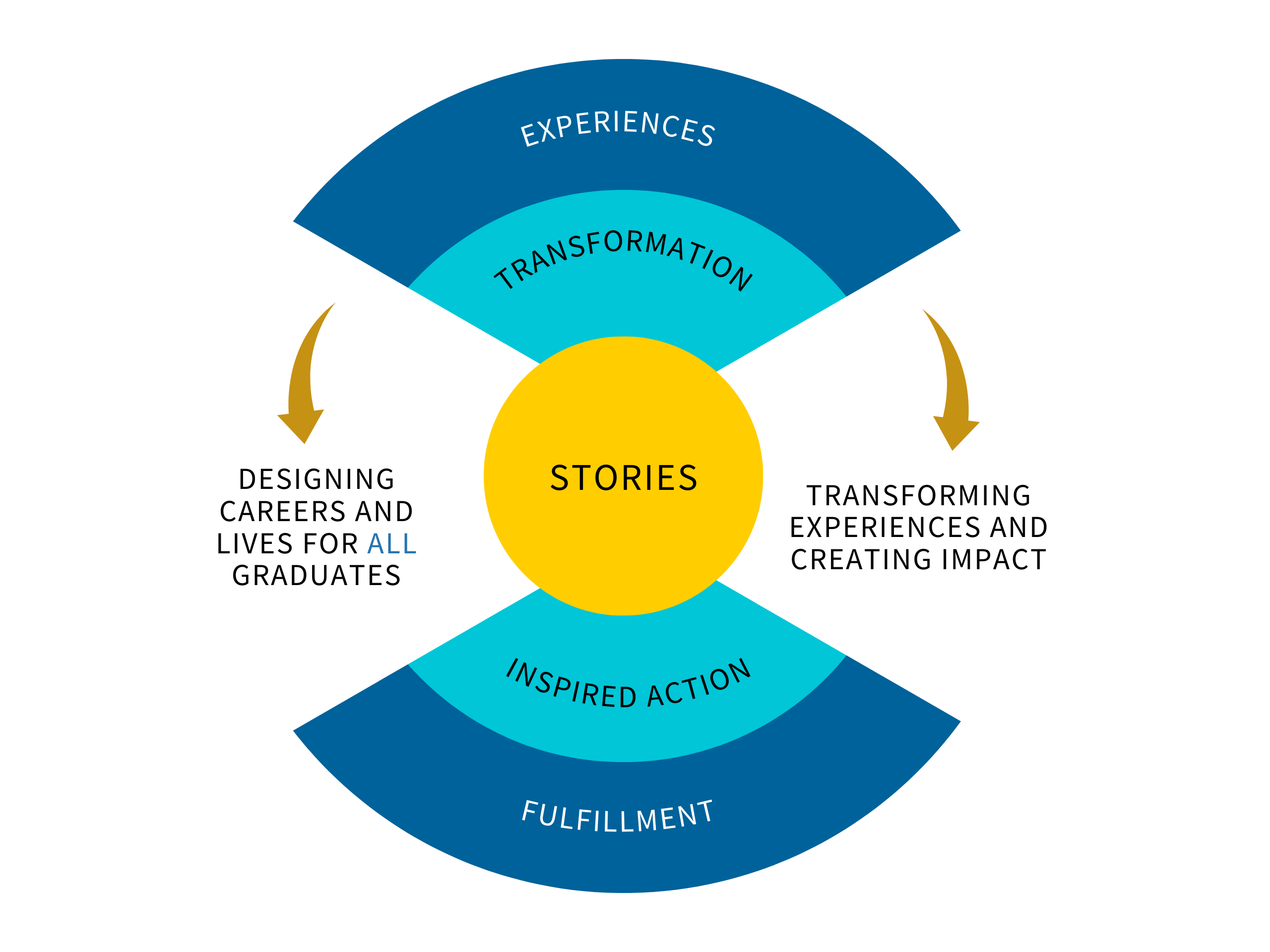
Transformation begins when we allow people to make meaning of their experiences—when we treat mentorship not as a checkbox, but as a chance to ask, “What’s your story, and where does it go next?” But before moving to the “next” part, we have to validate that the story that you tell yourself, about yourself, is yours! Not someone else’s. From there, you have ownership, followed by action. This naturally becomes more intentional, more authentic, and more connected to values. And fulfillment? That’s the reward of being able to write your own narrative with conviction. After all, you are the author, right?
This chart affirms that designing connected workplaces means designing space for people to evolve—not just professionally, but personally. It’s a safe space for them to write their own stories and adventures. In a world chasing metrics, you must stop chasing and re-evaluate the race itself. The boldest leaders build their legacies not by performance—but by the stories they helped others live, too.
Designing with Intention: Career, Life, and the Power to Lift Others
Career and life design is a mindset. It’s the understanding that our work and lives are not fixed paths, but creative acts of expression. When people are given the space to explore who they are, reflect on what matters, and imagine new possibilities, they begin to design with their internal north star, not their external north star. They stop chasing titles and start building lives that feel and are truly their own.
This is the heartbeat of holistic mentorship. Skills and strategy are limiting—true transformation is rooted in identity and agency. The best mentors do two things very well: 1) They care. And 2), They help others see what they can’t always see in themselves. We will give you a bonus, a number 3. They also make time. This goes beyond actively listening. These mentors clear the windshield and help mentees sit in the driver’s seat. It doesn’t matter what road they are on, how many stoplights there are, or whether it’s raining or snowing. They help them navigate their circumstances and empower them on a path to their destination, even if it’s outside their organization, or even in a different field altogether.
This is also what defines human leadership. Not control, but contribution. Not status, but service. Great leaders build cultures where people are invited to show up fully, speak freely, and stretch beyond what they thought was possible. They do not just direct progress—they design elevation.
Over the years, we have learned that the greatest leaders lift others by seeing them clearly—all of them—challenging them with compassion, and believing in their potential even before it’s fully formed.
The most impactful leaders don’t just desire to understand others—they look within to anchor and understand themselves—first. They lead from a place of self-awareness, knowing that true influence begins within. Grounded in who they are, they’re able to rise—and rise again—not just for their own sake, but to lift those around them. They show up with deeper connection: to themselves, to each other, and to the work that brings them alive.
The Neuroscience of Synergy
Belonging isn’t a luxury—it’s a human necessity. Neuroscience tells us that the brain responds to social connection the same way it does to physical safety or a warm meal. When people feel seen, heard, and truly safe, the brain releases oxytocin, the chemical that builds trust, deepens empathy, and fuels real collaboration.
In contrast, isolation and exclusion trigger the amygdala and cortisol responses, associated with uneasiness, fear, anxiety, and threat. Loneliness is not just sad—it is stressful. Chronic social disconnection impairs cognitive function, reduces motivation, and limits innovation.
Mentorship is a neurological catalyst. It nurtures environments where trust is the norm, not the exception, and where reflection is welcomed. We all need this—a place where we are encouraged to reflect, realign, and rewire.
Take job crafting, for example—a concept shaped by Yale researcher Amy Wrzesniewski. When individuals are given the freedom to reshape their roles around their strengths and values, it sparks their curiosity and they experience a noticeable boost in engagement, purpose, and overall well-being. Mentorship makes this possible. It offers the space for honest career and life vision reflection, deeper identity work and discovery, and the kind of intentional role redesign that transforms both people and performance.
Bottom line: real connectedness generates synergy. And synergy—when teams enter an invigorating rhythm of creativity, flow, and mutual respect—is one of the most powerful, supportive, and underrated cultural advantages any organization can use to thrive.
Self-Connectedness: The Foundation of Belonging
Burnout often begins not with workload—but with identity dissonance. It happens when people are forced to perform a version of themselves that feels disconnected from who they are. Over time, this disconnect becomes exhaustion.
Self-connectedness is the foundation for every other type of workplace connectedness. When individuals know their values, strengths, passions, and boundaries, they can engage with clarity and confidence. They can make decisions that align with their long-term career and life vision, rather than reacting to external pressure.
Mentorship nurtures self-connectedness. It offers a safe space for reflection, exploration, and visioning. The most influential mentors do not provide solutions; rather, they ask meaningful questions. They help individuals excavate their tales and rediscover their voices, sifting through dirt and limiting beliefs to unearth what is most important to them.
Redesigning the Future of Connected Work
Annual retreats do not create belonging; rather, daily rituals, inclusive systems, and courageous conversations do. The future workplace will not be defined by perks or platforms. It will be determined by its ability to build trust.
As artificial intelligence continues to automate technical tasks, what remains—and what becomes increasingly essential—are human capabilities: empathy, relationship-building, collaboration, and resilience. These are the skills that will distinguish high-performing teams from those that simply keep pace.
The most competitive organizations will not have the most advanced software. They will be the ones with the most intentional human culture. Workplaces that prioritize connectedness in their design will retain talent, unlock innovation, and sustain well-being on a scale.
The question becomes, how do we get there? To move forward, we have to let go of static culture models and start thinking in terms of adaptive design. Real culture change doesn’t happen overnight or through one-off programs, or mission statements—it’s something that should evolve continuously.
- Embedding mentorship at every stage of the employee experience.
- Developing leaders who understand the value of emotional intelligence, psychological safety, and inclusive communication.
- Making pathways for growth and feedback that are clear, not cryptic. These channels must be consistent, transparent, and visible. They should also be accessible. Individuals deserve to understand where they stand, and how to move forward—and most importantly, what’s possible.
- Shared rituals matter—and they matter—a lot. These are those special moments that bring people together from different departments that don’t always talk to each other. It brings diverse identities and roles to a common ground. These are the invisible threads that make a culture feel alive and human.
- And finally, we must stop measuring success only through performance metrics. We have to know how people are and if they feel they belong.
Let’s be honest and let’s make no mistake about it. The future of work is highly tech-enabled, no doubt. But, it’s also trust-enabled.
Call to Action
We would like to invite leaders across higher education, workforce development, and corporate talent strategy towards forming a national movement focused on workplace connectedness.
To fully catalyze this shift, we need three actionable initiatives:
1. Workplace Connectedness Task Force
It’s time to bring together a combination of HR leaders, career services professionals, and industry experts. Now, add mentorship thought leaders, diversity specialists, and organizational psychologists. Have them sit at the same table—not just to talk, but to build. Think of this like a design sprint for workplace connection.
Together, they will share benchmarks, discuss interdepartmental goals and metrics, and offer policy recommendations. This radical collaboration will help elevate connectedness as a foundation for retention, innovation, and more importantly—well-being.
2. National Summit on Belonging in the Future of Work
Gather students, employers, scholars, and policymakers in a national forum to exchange scalable models, showcase mentorship breakthroughs, and co-create a compelling vision for career and life readiness—one that places personal growth, career, and professional development on equal footing with identity exploration and talent discovery.
3. Practical Connectedness Toolkits
Create and distribute adaptable toolkits that allow organizations to assess their culture, measure belonging, activate mentorship ecosystems, and sustain authentic engagement—across in-person, hybrid, and remote environments.
Adding more programs won’t do the trick. You must embed purpose into the day-to-day—so that connectedness becomes a practice, not just a promise.
Learning that Listens: AI as a Catalyst for Personalized Connection
There’s no denying that Artificial Intelligence is changing how we engage with work—but its impact on how we learn, grow, and connect is just beginning to emerge. It’s becoming increasingly certain that AI is more than just automation and acceleration. When thoughtfully used, it can help us rediscover something we’ve lost—intentionality.
In many respects, AI is bringing personalization back to learning. The old one-size-fits-all model of development is no longer valid. Intelligent systems can now identify patterns, suggest learning pathways, and surface insights that support employees in designing their journeys.
This isn’t about replacing mentors—it’s about creating more access points to reflection, direction, and support. AI helps you scale and extend mentorship beyond what was possible before. Free AI-powered career agents like Aiya are transformative mentors, guiding individuals, and real-time insight.
Imagine a workplace where mentorship is ongoing—not limited by calendars or chance—but where the perfect connection, question, or learning moment can emerge when it’s most required. AI can help facilitate that. But it must be built with care, ethics, and a deep understanding of human needs.
The most efficient and effective tools are the ones that preserve humanity at the center.
As we think about the future of learning, we must ask better questions. How might we ensure every employee—regardless of background or social capital—has the ability to fully explore their potential?
Talent-based development would be easier if everyone knew their hidden talents. But this is not the case. So, the question becomes, how do we design systems that help people adapt, rather than asking people to adapt to systems?
We had it backwards. And how do we use AI to accelerate, optimize, and bring us closer to the learning, mentoring, and growth that so many crave?
We are not reacting to change—we’re actively designing through it. And as AI becomes part of the landscape, the opportunity isn’t just to learn faster. It’s to learn more meaningfully.
A New Standard of Engagement
Mentorship is not a byproduct—it is the foundation that binds culture together. A PwC survey reported that 93% of CEOs cite enhanced productivity, retention, and talent acquisition through mentoring.
Connectedness is not a soft metric—it is the new currency of engagement. And belonging is not a privilege—it is a leadership liability.
The future workplace won’t just happen on its own. It is going to be shaped by leaders who are bold enough to lead with empathy, prioritize inclusion, and design with both heart and intention.
Connectedness is not a bonus. What we design today will define how we belong tomorrow.
Yasir Kurt
Yasir Kurt is a forward-thinking serial entrepreneur, a design thinking expert, and a passionate advocate for international students and transformative education. Holding a Ph.D. in Counselor Education and Supervision.

Hassan Akmal
Hassan Akmal is the author of Redesigning Your Life: The AI Mosaic of Career and Life Design, a Global Career Services Thought Leader, Entrepreneur, Consultant, Future of Work Expert, and Founder of Aiya